
Think of your AI strategy as building a high-performance vehicle. Your InfoSec team builds the chassis, installs the locks, and secures the engine—making sure the car is safe from theft and tampering. But your AI governance program provides the driver’s manual, the rules of the road, and the GPS—ensuring the car is driven responsibly and reaches its destination without causing harm. The discussion of AI governance vs infosec is about recognizing that you need both a secure vehicle and a skilled driver. This article will demystify their separate but interconnected functions and show you how to create a unified framework where both teams work together to drive your AI initiatives forward safely and effectively.
Key Takeaways
- Recognize their distinct missions: AI governance sets the rules for responsible AI behavior by addressing fairness, ethics, and compliance. InfoSec protects the underlying data and systems from technical threats. They manage different but equally critical types of risk.
- Unify your strategy to cover all risks: Operating in silos creates dangerous gaps in your defenses. A complete risk management strategy requires both teams to align on goals, share risk assessments, and collaborate on data privacy to protect against technical and ethical failures.
- Create a framework that scales: A successful program moves beyond static policies. Build a lasting system by defining clear performance metrics, establishing a regular audit process, and using scalable tools to manage AI as its use grows across your organization.
AI Governance vs. InfoSec: What’s the Difference?
As organizations integrate AI into their operations, it’s easy to confuse AI governance with information security (InfoSec). While they are related and often work together, they have distinct roles. Think of it this way: InfoSec builds a secure fortress to protect your data, while AI governance sets the rules of engagement for the AI operating within that fortress. Understanding the specific functions of each is the first step toward building a comprehensive and responsible AI strategy. Let’s break down their core goals, scopes, and how they intersect.
Gevangee Desai, Cielo’ s VP of InfoSec, Compliance, and Security speaks about achieving both InfoSec and AI Goverance goals.
“If you imagine a house, ISO 27001 / InfoSec is the security—the locks on the doors and the strength of the walls. ISO 42001 / AI Governance, on the other hand, governs what happens inside the house: how the data is used, how fairness and bias are managed. They work in harmony—one keeps the structure secure, the other ensures what happens within it is responsible and trustworthy” [SOURCE: Cielo case study around ISO 42001 certification]
Their Core Functions and Goals
At its heart, AI governance is the framework of rules, processes, and tools your organization uses to manage the risks of AI. The primary goal is to ensure that every AI model is used responsibly, ethically, and in alignment with your company’s values and legal obligations. It’s about accountability—making sure your AI is fair, transparent, and reliable.
Information security, on the other hand, is the practice of protecting all of your organization’s information from unauthorized access, use, or disruption. Its main goal is to maintain the confidentiality, integrity, and availability of data. InfoSec creates the policies and controls that safeguard information assets across the entire enterprise, not just within AI systems.
How Their Scopes Differ
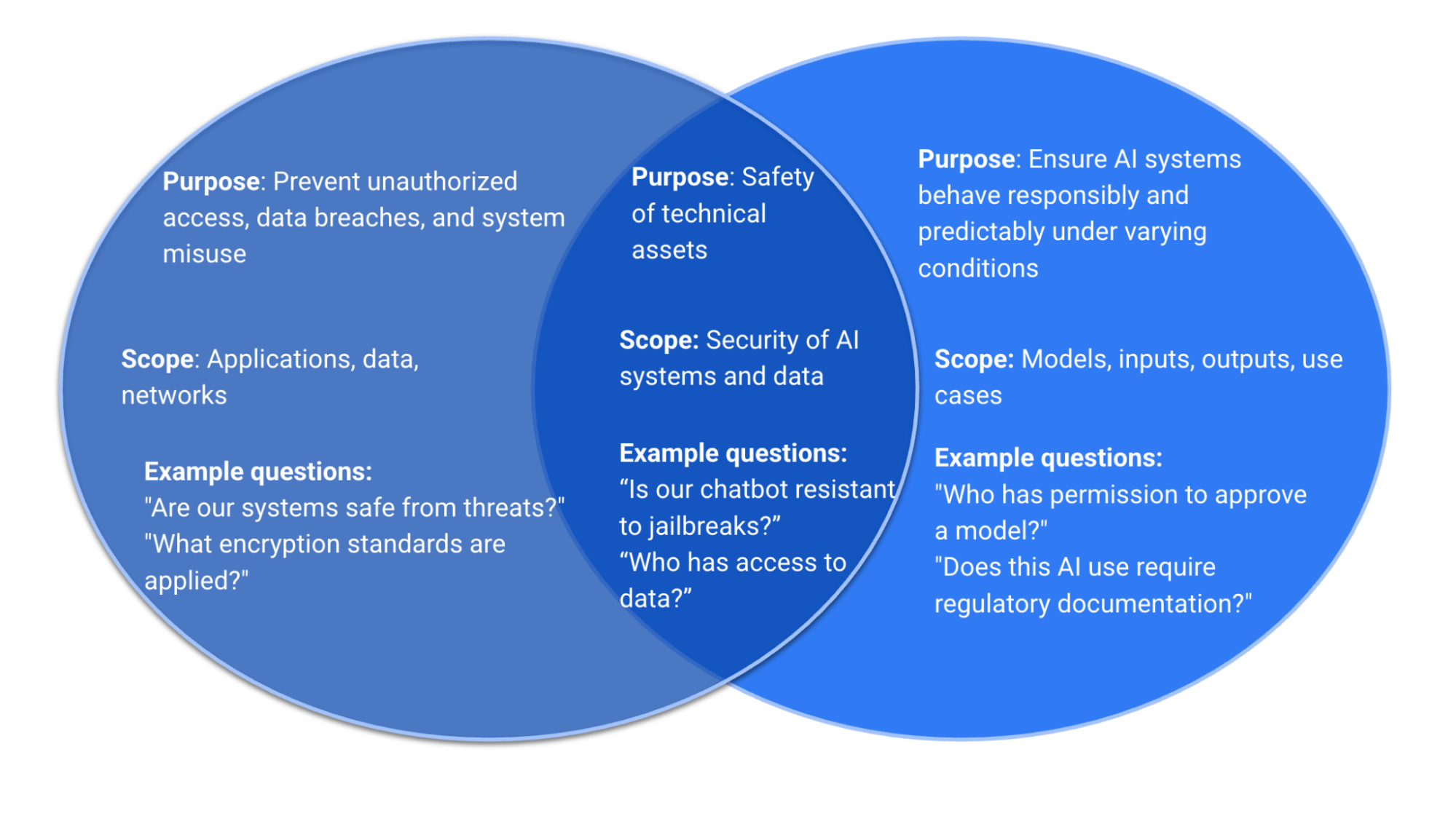
The most significant distinction between the two lies in their scope. AI governance has a specialized focus: the AI systems themselves. It addresses risks unique to artificial intelligence, such as algorithmic bias, model drift, and a lack of explainability. The central question for AI governance is, “Is this AI system trustworthy and behaving as it should?”
InfoSec has a much broader mandate. It is responsible for securing all company information, regardless of its format—from digital files and databases to paper documents. Its focus is on protecting data from external and internal threats, like cyberattacks or data breaches. The central question for InfoSec is, “Are our information systems and data protected from harm?”
Where Their Responsibilities Overlap
Neither function can operate effectively in a silo. AI governance and InfoSec must work in tandem to create a secure and responsible AI ecosystem. InfoSec provides the foundational security controls that protect the data used to train and run AI models. AI governance builds on that foundation, setting specific rules for how that data can be used by the AI to ensure fairness and prevent misuse.
This collaboration is essential for managing risk. For example, an InfoSec team might implement access controls for a sensitive dataset, while the AI governance committee defines policies to prevent that data from being used in a way that introduces bias into a model. True success depends on these teams working together to align on goals, share insights, and enforce policies across the board.
Dive deeper into understanding how AI Governance differs from related domains: Read more in AI Governance, Explained
What is Modern AI Governance?
Think of modern AI governance as the complete operational playbook for using artificial intelligence responsibly and effectively across your organization. It’s not just a dusty policy document; it’s a living system of rules, roles, and tools that guide how you build, deploy, and manage AI. This system helps you get the most out of AI while protecting your organization from its potential risks. A strong governance program provides the structure needed to manage everything from internal tools and vendor models to employee-led AI projects.
Effective AI governance is built on a few key pillars. It starts with a solid risk framework to identify and handle potential issues. It also directly addresses ethics and fairness to prevent bias and build trust. At the same time, it ensures you stay on the right side of rapidly changing regulations. Finally, it includes continuous monitoring and validation to make sure your AI models perform as expected over their entire lifecycle. By putting these pieces in place, you create a clear, consistent, and scalable approach to managing AI.
Establish a Risk Framework
A risk framework is your foundation for making sound decisions about AI. It’s a structured process for identifying, assessing, and mitigating the potential downsides of using AI systems. These risks can range from technical glitches and data privacy breaches to reputational damage and legal penalties. The goal is to create a clear set of rules and responsibilities so your teams understand the potential impacts of the AI they’re developing or procuring. This isn’t a one-time check, but an ongoing practice that adapts as your AI use cases and the technology itself evolve. A well-defined risk management framework gives your organization the confidence to move forward with AI initiatives, knowing you have a plan to handle whatever comes your way.
Address Ethics and Fairness
Beyond technical performance, your AI systems must operate ethically and fairly. This means actively working to identify and mitigate biases that can lead to inequitable outcomes, especially in sensitive areas like hiring, lending, and customer service. Modern AI governance incorporates fairness and transparency metrics directly into the development and monitoring process. These checks help ensure your models treat all individuals equitably and that their decision-making is as transparent as possible. Addressing AI ethics isn’t just about compliance; it’s about building and maintaining trust with your customers, employees, and the public. When people trust that your AI is fair, they are more likely to embrace it.
Meet Compliance Requirements
The regulatory landscape for AI is changing quickly. Governments around the world are introducing new laws, like the EU AI Act, that set firm rules for how organizations can use artificial intelligence. A core function of modern AI governance is to ensure your organization can meet these compliance requirements. This involves staying informed about new and upcoming regulations, documenting your AI systems and their risks, and being prepared for audits. An effective governance program translates complex legal requirements into clear, actionable steps for your teams. This proactive approach helps you avoid fines and demonstrates your commitment to responsible AI practices, which can become a significant competitive advantage.
Monitor and Validate Models
AI governance doesn’t end when a model goes live. In fact, that’s when some of the most important work begins. Continuous monitoring and validation are essential for ensuring your AI systems perform reliably and safely over time. Models can degrade, data can drift, and performance issues can emerge unexpectedly. That’s why it’s crucial to test AI systems thoroughly before deployment and keep a close watch on them afterward. By implementing a robust model monitoring strategy, you can catch performance issues or ethical problems early, before they impact your customers or your business. This ongoing oversight is a critical part of the AI lifecycle and a key component of any lasting governance program.
What Are the Core Parts of InfoSec?
Information Security, or InfoSec, is the framework of policies, tools, and practices an organization uses to protect its digital and physical information. It’s a foundational discipline focused on preventing unauthorized access, use, disclosure, disruption, modification, or destruction of data. Think of it as your organization’s comprehensive defense system. While AI governance focuses on the ethical and compliant use of AI models, InfoSec is concerned with the security of the underlying data and systems that power them.
A strong InfoSec program is built on a few key pillars that work together to create a resilient security posture. It’s not just about installing firewalls or running antivirus software; it’s a strategic approach that involves protecting data at its core, implementing specific controls to enforce security policies, actively hunting for and responding to threats, and meticulously managing who has access to what. Each of these components is critical for safeguarding your company’s most valuable asset: its information. Understanding these functions helps clarify where InfoSec’s responsibilities lie and how they support broader governance efforts, including those for AI.
Protect Your Data
At its heart, InfoSec is about protecting information from harm. This means keeping sensitive data out of the wrong hands, preventing it from being stolen, and ensuring it isn’t accidentally lost or deleted. The first step is understanding what data you have and how sensitive it is through a process called data classification. By categorizing data based on its value and risk level, you can apply the right level of protection. This core function is about maintaining the confidentiality and integrity of your information, whether it’s stored on a server, moving across a network, or being used in an application.
Implement Security Controls
Protecting data requires putting specific safeguards in place. These are known as security controls, which are the technical tools and formal policies you use to enforce your security rules. This includes everything from firewalls and encryption that shield your network to internal policies that dictate how employees should handle sensitive information. These controls are your first line of defense against threats. They are intentionally designed to reduce risk by preventing security incidents from happening, detecting them if they do, and providing a framework for resolving any issues that arise. A well-designed security control strategy is layered, ensuring that multiple defenses stand between a threat and your critical data.
Detect and Respond to Threats
No defense is perfect, which is why a critical part of InfoSec is the ability to find and fix weaknesses before they can be exploited. This involves continuous monitoring of your systems to detect suspicious activity and having a clear, actionable incident response plan for when a security event occurs. The goal is to identify threats quickly, contain the damage, and restore normal operations as soon as possible. This proactive and reactive approach ensures that your organization is not only prepared to defend against attacks but is also resilient enough to recover from them while minimizing business disruption.
Manage Access and Authentication
A significant portion of data breaches stems from unauthorized access. That’s why managing who can see and interact with your data is a cornerstone of InfoSec. This is handled through Identity and Access Management (IAM), which ensures that only authorized individuals can access specific information. A key concept here is the principle of least privilege, where users are only given the minimum levels of access needed to perform their job functions. This is paired with strong authentication methods, like multi-factor authentication (MFA), to verify that users are who they claim to be, adding another crucial layer of security.
How AI Governance and InfoSec Work Together
Information Security and AI governance are not competing functions; they are essential partners in protecting your organization. While InfoSec focuses on securing the technological infrastructure—the networks, servers, and data storage—
When these two teams work in isolation, critical gaps appear. Your systems might be protected from external breaches, but an unmonitored AI model could still introduce bias into hiring decisions or generate inaccurate financial reports, exposing the company to legal and reputational damage. A truly effective risk management strategy requires a unified approach where both teams collaborate to cover all potential vulnerabilities, from the technical to the ethical. By aligning their goals, sharing insights from risk assessments, and upholding data privacy together, they create a comprehensive defense that supports confident AI adoption across the enterprise.
Align on Security Goals
The first step toward effective collaboration is establishing a shared understanding of what it means to protect an AI system. InfoSec’s primary goal is to prevent unauthorized access, data breaches, and system failures. Their work confirms the AI is secure from a technical standpoint. However, AI governance protects the AI models themselves, making sure they don’t cause harm or break rules, even if they are technically secure. For example, InfoSec might prevent a cyberattack on a credit approval model, while AI governance confirms the model doesn’t unfairly deny loans based on demographic data. Both teams must align on a holistic definition of security that includes both technical integrity and operational responsibility.
Uphold Data Privacy
AI models are powered by data, and both InfoSec and AI governance play critical roles in protecting it. InfoSec is responsible for implementing the security controls that safeguard data from breaches, such as encryption and access management. AI governance, on the other hand, sets the policies for how that data can be used ethically and in compliance with regulations like GDPR. Governing this data according to clear data privacy policies and security protocols is crucial to the responsible use of AI. This partnership confirms that sensitive information is not only secure from external threats but is also handled responsibly throughout the entire AI lifecycle, from training to deployment.
Integrate Risk Assessments
InfoSec and AI governance teams assess risk from different but complementary perspectives. An InfoSec risk assessment might identify a vulnerability in the software library used by an AI model. In contrast, an AI governance assessment would focus on the model’s potential for biased outputs or its lack of transparency. Integrating these assessments provides a complete, 360-degree view of AI risk. A well-defined AI governance framework relies on comprehensive metrics to confirm your AI systems are effective, fair, and transparent. By combining their findings, both teams can prioritize threats more effectively and develop mitigation strategies that address both technical and ethical vulnerabilities.
Foster Cross-Team Collaboration
Building a strong partnership between AI governance and InfoSec requires more than just aligned goals; it demands active, ongoing collaboration. This means creating structures that facilitate communication, such as joint committee meetings, shared reporting dashboards, and integrated workflows. True collaboration should also extend beyond these two teams to include data science, legal, IT, and business operations. This creates a comprehensive understanding and effective implementation of AI governance policies. When all stakeholders have a seat at the table, your organization can move from simply having policies on paper to embedding responsible AI practices into its culture.
Address Emerging AI-Specific Threats
As AI systems become more integrated into core business operations, new categories of risk are emerging that traditional InfoSec frameworks alone cannot fully address. Attacks such as data poisoning, model inversion, and prompt injection exploit the unique mechanics of machine learning models rather than the underlying infrastructure. These vulnerabilities can expose sensitive training data, manipulate outputs, or compromise downstream systems. By collaborating, InfoSec and AI governance teams can identify and mitigate these AI-specific threats early—embedding security and ethical safeguards into the model lifecycle. This includes evaluating third-party model dependencies, monitoring for abnormal model behavior, and ensuring that both technical and policy responses evolve alongside the rapidly changing AI threat landscape
Overcome Common Implementation Challenges
Bringing AI governance and InfoSec together isn’t always a smooth process. You’re likely to hit a few common bumps in the road, from skill gaps to conflicting rules. But with a clear strategy, you can work through these issues and build a stronger, more resilient program that supports responsible AI adoption.
Close Resource and Expertise Gaps
AI governance is a team sport. Your data scientists, IT pros, legal counsel, and business leaders all have a piece of the puzzle. Bringing these groups together helps you pool internal knowledge and see the full picture. This collaboration is key to developing effective AI governance metrics and identifying where you might need to invest in new training or tools. A cross-functional team ensures that your governance strategy is comprehensive and practical, not just a policy that sits on a shelf.
Align Competing Policies
It’s common for InfoSec’s strict data handling policies to clash with an AI team’s need for broad data access. Instead of letting teams operate in silos, your goal is to create a unified framework. This means defining clear, comprehensive metrics that satisfy both security requirements and AI performance goals. A well-defined AI governance framework helps you find the right balance, ensuring your AI systems are effective, fair, and secure without creating unnecessary roadblocks for your teams. It’s about creating shared rules of the road.
Address Complex Threats
AI introduces security risks that your standard InfoSec playbook might not cover, like model inversion or data poisoning attacks. Your security team needs to understand these unique vulnerabilities to protect your systems. This requires close partnership with your AI teams to develop specific security metrics and controls for your models. By proactively identifying and planning for these emerging AI threats, you can ensure your defenses are strong enough to handle the specific challenges that AI systems present, protecting both your models and the data they use.
How to Build an Effective Integration Strategy
An effective integration strategy brings your AI governance and InfoSec teams together under a unified plan. Instead of operating in separate silos, they can work from a shared playbook to manage risks and support responsible AI adoption. This isn’t just about checking compliance boxes; it’s about building a resilient foundation that allows your organization to scale its AI initiatives with confidence. A successful strategy aligns both teams on common goals, establishes clear lines of communication, and creates repeatable processes for managing the entire AI lifecycle.
The key is to be deliberate. Don’t let your integration strategy happen by accident. It requires thoughtful planning to define how these two critical functions will collaborate on everything from policy creation to incident response. By outlining a clear path forward, you can prevent the friction that often arises when security and governance priorities compete. This proactive approach means security controls are built into AI systems from the start and that governance principles guide every stage of development and deployment. The result is a more secure, ethical, and compliant AI ecosystem that everyone in the organization can trust.
Develop and Document Clear Policies
Your first step is to create and document clear policies that serve as the foundation for your integrated strategy. These aren’t just for your technical teams; they should be accessible and understandable for everyone involved in the AI lifecycle. Your policies need to cover critical areas like data quality for training models, data privacy, model development standards, and ongoing monitoring. Think of this as your organization’s rulebook for AI. Documenting these processes creates consistency and gives every team member a clear reference point for how to handle AI responsibly. When everyone understands the expectations, it’s much easier to maintain alignment between your governance and security efforts. Policies should clearly demarcate where accountability lies, which is especially important in integrated teams.
Choose Your Risk Assessment Methods
Once your policies are in place, you need a consistent way to identify and evaluate potential risks. This means selecting risk assessment methods that address both technical and ethical concerns. Your InfoSec team can focus on security metrics to protect systems from vulnerabilities and attacks, while your AI governance team can evaluate the ethical and social impact of your models. The goal is to create a holistic view of risk that considers everything from data breaches to algorithmic bias. By using a comprehensive framework, you can prioritize the most significant threats and allocate resources where they’re needed most, making your AI systems both secure and fair.
Define How You’ll Measure Performance
Defining the right metrics is at the heart of effective AI governance. Without clear measures, it’s impossible to know whether your controls are working or your risks are growing. Metrics should capture both technical performance and governance outcomes — from model accuracy, fairness, and drift detection rates to policy compliance, audit readiness, and incident response times. They need to be actionable, not just descriptive: a metric should tell you when to intervene, retrain, or review a model. Establishing thresholds and ownership for each metric ensures accountability across teams, while regular review cycles keep them aligned with evolving business goals and regulatory expectations. In short, good AI governance metrics turn abstract principles like “transparency” and “responsibility” into measurable, trackable realities.
Outline Your Tech Infrastructure Needs
Your strategy is only as strong as the technology that supports it. You need the right infrastructure to enforce your policies and monitor performance effectively. This includes tools for managing data quality, observing model behavior, controlling data access, and protecting user privacy. A centralized AI governance platform can help you automate risk tracking and streamline compliance across all your AI use cases, from internal tools to third-party models. By outlining your tech infrastructure needs early on, you can give your teams the capabilities required to implement your integrated strategy successfully and manage AI at scale.
Create a Framework That Lasts
A successful integration of AI governance and InfoSec isn’t a project with an end date; it’s a continuous practice. Building a framework that can stand the test of time requires a forward-thinking approach that anticipates change. Your strategy should be designed to be resilient, adaptable, and scalable from day one. This means moving beyond static policies and creating a living system that evolves with your organization, the technology, and the regulatory environment. By focusing on a few key areas, you can build a durable structure that supports responsible AI adoption for years to come.
Design an Adaptable Governance Structure
Your AI governance framework is the foundation of your entire strategy. At its core, AI governance is the complete set of rules, steps, roles, and tools your organization uses to manage AI risks and ensure responsible use. But this foundation can’t be rigid. As your company adopts new AI tools and your business objectives shift, your governance structure must be flexible enough to adapt. This involves establishing clear accountability, defining processes for model review and approval, and scheduling regular check-ins to update policies. Think of it as a constitution for your AI program—a guiding document that can be amended as your organization grows and learns.
Evolve Your Security Measures
AI introduces new dimensions to information security. As one expert notes, “cybersecurity and AI governance are very closely connected and both are needed to make AI safe and fair.” Your security measures must evolve to address AI-specific threats, such as model tampering or data poisoning, which can compromise your systems in novel ways. A lasting framework includes processes for continuously identifying and mitigating these emerging risks. This means your InfoSec and AI governance teams need to work together to update threat models, test AI systems for vulnerabilities, and adapt security controls to protect both your data and the integrity of your models. The OWASP LLM Top 10 provides a valuable benchmark here for generative AI systems—highlighting the most critical security risks specific to large language models and guiding organizations in building safer, more resilient AI systems.
Maintain Regulatory Readiness
The rules governing AI are changing quickly, and your framework needs to keep pace. With major regulations like the EU AI Act on the horizon, organizations must be prepared to comply with new and detailed requirements. A durable framework includes a proactive process for regulatory intelligence—actively monitoring, interpreting, and preparing for new laws before they take effect. This prevents last-minute compliance fire drills and positions your organization as a leader in responsible AI. By building regulatory adaptability into your program, you can confidently deploy AI systems knowing you are prepared for what comes next.
Implement Scalable Solutions
As your organization’s use of AI grows from a handful of pilot projects to enterprise-wide deployment, your governance framework must be able to scale with it. Manual tracking and ad-hoc reviews simply won’t work when you have hundreds of models to manage. A well-defined AI governance framework relies on comprehensive metrics and automated tools to monitor performance, fairness, and compliance across the board. Implementing scalable solutions like the FairNow platform allows you to maintain consistent oversight without slowing down your teams. This ensures that as your AI footprint expands, your ability to govern it effectively expands right along with it.
Related Articles
- AI Governance, Explained – FairNow
- AI Governance vs. Data Governance: Key Differences & Synergies – FairNow
- [YouTube] How Cielo’s VP of InfoSec, Comliance and Security view InfoSec / ISO 27001 and AI Governance / ISO 42001 together
Learn more about what an AI Governance Platform.

Explore what an AI governance platform offers at https://fairnow.ai/platform/
AI Governance vs. InfoSec FAQs
My InfoSec team is great. Why can't they just handle AI governance too?
Think of it this way: your InfoSec team builds a secure vault to protect your data, which is a critical job. AI governance, however, sets the rules for what the AI is allowed to do with the data inside that vault. InfoSec prevents breaches and protects systems, while AI governance addresses risks unique to AI, like algorithmic bias or unfair outcomes. You need both skill sets because a perfectly secure AI model can still create significant legal and reputational damage if its logic is flawed or biased.
This integration seems complex. What's the most important first step to take?
The best place to start is by getting the right people in the same room. Form a cross-functional AI governance committee that includes leaders from InfoSec, legal, data science, and key business units. Your first task should be to create a shared understanding of the risks and establish a common language. This initial alignment is the foundation for developing clear policies and a unified strategy that everyone can support.
Who should ultimately own the integration of AI governance and InfoSec?
While a specific leader, like a Chief AI Officer, might spearhead the effort, true ownership is a shared responsibility. It’s not a task you can assign to a single person or department. The most effective approach is to have your cross-functional governance committee collectively own the strategy, with clear roles defined for both the InfoSec and AI governance teams. This collaborative structure prevents silos and confirms that both technical security and ethical oversight are always prioritized.
Does our approach need to change for AI we build ourselves versus AI we buy from vendors?
Yes, your approach will definitely need to be different. For AI you build internally, you have direct control over the entire lifecycle, from data selection to model training and monitoring. For vendor-provided AI, your focus shifts to rigorous due diligence. You need to scrutinize vendor security practices, demand transparency into their models, and establish clear contractual requirements for fairness, monitoring, and compliance before you integrate their tool into your operations.
What's the biggest mistake you see companies make when trying to bring these two functions together?
The most common mistake is treating integration as a one-time project with a finish line. They create a policy document, hold a few meetings, and consider the job done. But AI and its associated risks are constantly evolving. An effective framework is a living system that requires continuous monitoring, regular policy updates, and ongoing collaboration. Success comes from embedding this partnership into your company culture, not just checking it off a to-do list.
